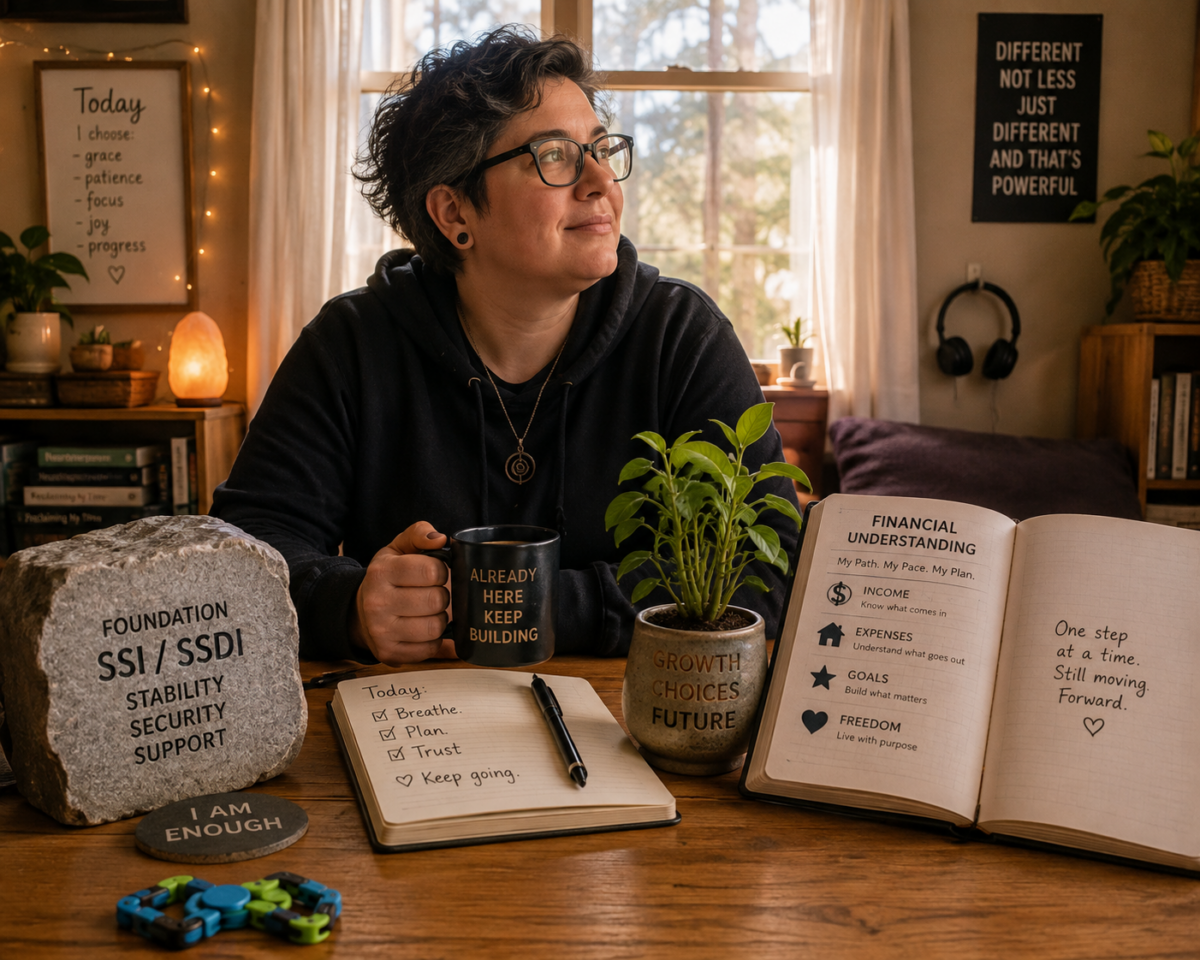
I work alongside people navigating SSI and SSDI every single day. The story I sometimes hear? “I’m on benefits so I’m dependent. Broken. Can’t work.” The shame is real. The fear is real.
But after years watching people build lives grounded in these benefits, I know something different: SSI and SSDI aren’t a ceiling. They’re a foundation. Not someday when you escape the system. Right now, with benefits in hand, understanding them strategically, moving toward genuine self-determination.
I’ve watched people move from shame to strategy. From “I’m broken” to “I’m resourceful.” These aren’t small shifts. They’re everything.
This article is for you — the neurodivergent, disabled communities navigating SSDI/SSI, wondering: Can I actually work? Can I build a life? Can I become truly independent?
The answer is yes.
—————
SECTION 1: UNDERSTANDING SSDI & SSI
Let’s start simple.
SSI (Supplemental Security Income) is need-based income support. If you have a disability, are blind, or are 65+, and your income is limited, SSI helps cover basics — rent, food, utilities. The powerful part? It usually includes Medicaid, which covers healthcare. That matters when you’re managing medication, therapy, and the costs that come with neurodivergence/disabilities.
SSDI (Social Security Disability Insurance) works differently. It’s based on work history — yours or a parent’s/spouse’s earnings record. No resource limits (game-changer for saving). After 24 months, you get Medicare instead of Medicaid. More freedom to work without immediately losing benefits.
The difference is crucial: they have different rules, different work incentives, different pathways. Knowing which one you have means knowing your options.
Real talk: Both exist because people need support to thrive. That’s not weakness — that’s wisdom. Your disability isn’t shameful. Your need for support isn’t failure. Your benefits are earned through your lived experience. Stop apologizing. Use them strategically.
—————
SECTION 2: YES, YOU CAN WORK (AND KEEP YOUR BENEFITS)
Most people think: “If I work, I lose everything.” It’s the biggest barrier to even trying. The fear is real. The misinformation is everywhere.
The truth: You can work. The system has built-in pathways designed to help you try.
If you’re on SSDI:
- Trial Work Period (9 months): Earn any amount, keep full benefits. Test-drive a job with zero risk. See if it fits your neurodivergent needs, your sensory tolerance, your pace.
- Extended Eligibility (3 years after): Benefits gradually reduce based on earnings, but don’t disappear. Manageable slope, not a cliff.
- Expedited Reinstatement: If working doesn’t work out, get back on benefits quickly. The system has an off-ramp built in.
If you’re on SSI:
- Plan to Achieve Self-Support (PASS): Set aside income for a goal (education, business, skill-building). That money doesn’t count against SSI limits. You can work and save toward something simultaneously.
- Impairment Related Work Expenses (IRWE): Work-related disability expenses (sensory tools, transportation, therapy) don’t count toward income limits. They reduce your counted income, helping you keep benefits longer.
- Student Earned Income Exclusion: If you’re under 22 and in school, first $2,000/month doesn’t count against SSI.
These programs exist because policymakers understood something fundamental: people on benefits want to work. The system should support that trying, not punish it.
—————
SECTION 3: BUDGETING WITH SSDI/SSI
Know your exact monthly benefit. Write it down. No estimating. This number is your foundation.
Here’s what changes everything: separate your budget into three layers:
- Survival costs: Rent, food, utilities, medications. Non-negotiable.
- Accommodation costs: Therapy, sensory tools, transportation, medication copays, accessibility equipment. These aren’t luxuries — they’re the difference between functioning and crashing.
- Thriving costs: Coffee, connection, hobbies, time with people you love. These matter. Burnout happens when you cut these out.
When you separate these three layers, you see you’re not just surviving on an impossible number. You’re strategically allocating resources to three equally important categories. That’s wisdom.
Practical hacks that real people use:
- Community centers and libraries (free programming)
- Meal prep and bulk buying (stretches food dollars)
- Shared housing (cuts rent in half or more)
- PASS plans (set aside money without losing SSI benefits)
Real truth: You’re not “bad with money.” The system is tight. Strategic budgeting is power. It’s saying: “I see my reality clearly, I’m allocating resources intentionally, and I’m building forward.” That’s how independence works.
Also, consider opening an ABLE account. ABLE accounts are a great way for people to save money above the $2,000. And still maintain their benefits. They are now available to anyone who became disabled before the age of 46. For further details, see the ABLE resources for these in the references section at the end.
—————
SECTION 4: PROTECTING YOUR BENEFITS
Common SSI mistakes:
- Not reporting changes (new job, moved, relationship status, med costs) → creates overpayment debt
- Hiding income → gets caught, massive repayment required
- Ignoring resource limits ($2,000 max) → benefits pause. Plan with a counselor before receiving inheritances or large gifts.
- Missing work incentive deadlines → missed opportunities
Common SSDI mistakes:
- Assuming you can’t work (you can — use those incentives)
- Not understanding Medicare vs. Medicaid (transition happens at 24 months)
- Not tracking earnings carefully → SSA will cross-check
- Not keeping paperwork organized
- Not staying under the earnings cap
Protect yourself:
✓ Create a system for all SSA documents (physical or digital)
✓ Set phone reminders for reporting deadlines
✓ Trust peer support — if someone figured it out, learn from them
✓ Ask for written confirmation whenever you report to SSA
✓ Know your advocates (disability rights organizations, legal aid, benefits counselors)
—————
SECTION 5: FINANCIAL LITERACY — BUILDING TOWARD INDEPENDENCE
Independence doesn’t mean “no benefits.” Real independence means: You understand your money. You make deliberate choices. You build forward.
Know your monthly income from all sources (benefits, work, peer support) and your fixed/flexible expenses. This isn’t punishment — it’s clarity. Clarity is power.
Separate your identity from your income. Your worth ≠ your paycheck. As my coworker’s dad use to say: “don’t feel bad about getting benefits. I paid in more than I will ever get back.” Being on benefits doesn’t make you incapable. Your disability/neurodivergence isn’t your limitation — it’s part of how you see the world. Financial struggle isn’t personal failure. It’s circumstance. When you make this separation, shame loses its grip.
Diversify your resources: Part-time work + peer support income + side skills + shared housing. Multiple small streams create resilience. If one dries up, you’re not devastated.
Invest in yourself: Free courses, therapy, meditation, time with people who matter. These aren’t optional — they’re foundational. A person who’s burnt out can’t build forward.
Think forward: What does independence look like for you specifically? What skills would that require? What’s one concrete step this month? When you answer these, independence stops being abstract. It becomes possible.
Neurodivergent reality: Executive function is real. If tracking money is hard, use apps or ask for help. That’s accommodation, not weakness. Overwhelm is real. Start small — one number, one bill, one goal at a time. Shame is the enemy of change. Everyone makes mistakes. That’s data, not destiny.
—————
SECTION 6: CONSUMER STORIES
Story 1: Trial Work Period Risk Paid Off
“I was terrified to work. My counselor explained the Trial Work Period — nine months where I could earn anything and keep full SSDI benefits. I took a part-time bookstore job. First three months were hard. Sensory overload, anxiety, exhaustion. I almost quit. But by month five, I realized: I could do this. My SSDI didn’t disappear. The benefits kept flowing while I built confidence. Now I’m looking at career paths I never thought possible. I’m still on SSDI, still have healthcare, but now I have purpose too. That changed everything.”
Story 2: PASS Plan to Education
“School felt impossible. My SSI was my lifeline — I thought education meant losing everything. My counselor showed me PASS: I could set aside work income for tuition without it counting against SSI. I work part-time, set money aside for classes, keep my benefits, and work toward my degree simultaneously. It’s not fast, not easy, but it’s possible. That financial safety net underneath makes it sustainable.”
Story 3: Shame to Strategy
“I used to hide my SSI status. I felt like failure. Then I met people in peer support who were grounded in their benefits while building beautiful lives. They didn’t apologize. They said ‘My SSI is my foundation, here’s what I’m building on top of it.’ That reframe changed everything. I stopped seeing benefits as a ceiling and started seeing them as a floor. A solid place to stand. Now I own my benefits story instead of being ashamed of it.”
—————
SECTION 7: FROM DEPENDENT TO SELF-DETERMINING
The real shift:
Old story: “I’m on benefits so I’m dependent. Broken. Can’t work.”
New story: “I’m using benefits strategically while building toward my goals. My neurodivergence/disability is part of who I am. I’m resilient. I’m resourceful.”
Real independence looks like:
- You know your numbers
- You make strategic choices about work, budgeting, forward-building
- You’re grounded in gratitude (benefits exist, use them intentionally)
- You’re building through small, consistent steps
- You’re connected to community (peer support, mutual aid, people who get it)
- You’re becoming self-determining
By end of this month, check in with yourself:
Can you answer these?
✓ What’s my exact monthly benefit?
✓ What work incentives apply to me?
✓ What does my realistic budget look like?
✓ What’s one goal I’m building toward?
✓ Who’s my support ally?
✓ What’s one accommodation I need to ask for?
If you can answer those, you’re not dependent.
You’re resourceful. You’re grounded. You’re building.
—————
CLOSING
SSDI and SSI aren’t charity. They’re recognition that you matter. That your contributions matter. That your neurodivergent, disabled self has value.
While you’re rebuilding, recovering, or reimagining — these benefits are your foundation. Use them strategically. Understand them fully. Build forward from them. Ask for help. Celebrate small wins. Connect with community. Trust your wisdom.
Not someday. Right now.
RESOURCES
- Social Security local office (78 Center St, Pittsfield, MA 01201) Tel: (866) 446-7111 – check which benefits you could be entitled to.
- SSA.gov Benefit Calculators: https://www.ssa.gov/benefits/calculators/ — Verify earnings and plan benefits.
- My Social Security Account: https://www.ssa.gov/myaccount — Create account to access your earnings record and estimate benefits.
- Work Without Limits – Work Incentives Planning and Assistance (WIPA)https://www.workwithoutlimits.org/benefits-counseling/wipa-home/ – Provides one-on-one counseling on the impact of work earnings or wage increases on:
- Cash benefits (Supplemental Security Income (SSI)/Social Security Disability Insurance (SSDI))
- Health insurance (MassHealth/Medicare)
- Other public benefits (Housing, SNAP, etc.)
- If you do not qualify for WIPA – call Social Security Ticket To Work Toll-Free Help Line: 1-866-968-7842
- Massachusetts Vocational Rehabilitation Office: Disability employment support, benefits counseling, and job placement – MassAbility – https://www.mass.gov/orgs/massability
- National Foundation for Credit Counseling (NFCC): https://www.nfcc.org/ — Nonprofit financial counseling in all 50 states.
- Support in applying (and with paperwork) for SSI & SSDI: AdLib – https://www.adlibcil.org/ – (413) – 442-7047.
- ABLE accounts with Social Security benefits: https://www.ssa.gov/ssi/spotlights/spot-able.html
- ABLE National Resource Center: Resources, how to apply, and other information on ABLE accounts: https://www.ablenrc.org/